Showing posts with label Paul Richards. Show all posts

Sunday, July 8, 2018

Paul Richards Flip Book


Not long ago I received an envelope from 'Friend of Everyone's Blog', Mark Hoyle. In that envelope was this beauty, a 1957 Gillette-sponsored 'flip book' featuring Orioles manager/GM Paul Richards demonstrating baseball signs.  Mark sent an item that is right in my wheelhouse as he knows how much I love adding unique pieces to my Orioles collection. Photos can't do this thing justice. And that's a shame because it's really a cool little book.

This shot gives an idea of the size of the booklet. Yes, I used a Red Sox card intentionally :-)


There are multiple 'movies' that are viewed by flipping the two sets of split pages in both directions. The mini-movies and accompanying text cover all the different signs used in baseball, coaches signaling batters and runners, catchers calling pitches, etc.

I did some digging and couldn't find any Gillette flip books on other baseball subjects so it appears this was a one-off. Keyman Collectibles has an entry for this and gives the following backstory:

The 1957 Gillette "Signals... The Secret Language of Baseball in Finger-Tip Movies" by Bob Broeg, VP Baseball Writers Association, was a premium flip book that came with a Gillette Super-Speed Razor. The booklet was held in place, below the case with a specially marked, cardboard band. The material in this book is based on a series of articles that appeared in The Sporting News, national baseball weekly and Joe Garagiola served as technical adviser. The booklet has a total of 8 "Finger-Tip Movies" that all feature black and white illustrations of Baltimore Orioles manager, Paul Richards.
They also have a picture of the original Gillette packaging which is viewable through that link.

As I said the photos don't really capture the charm of this but I wasn't able to juggle the booklet and take a video of it in action. These pics will have to do.


The timing of Mark's gift was perfect as I am in the process of building a couple of displays of Orioles pieces. They will contain things that don't work well in binders like pins, trinkets, and patches. I'm using glass-front, wall-mounted boxes. This booklet will fit in for sure.


Thanks again, Mark. This little treasure is much appreciated!

Saturday, November 22, 2014

Cardboard Art 1933 Goudey Paul Richards


Just a quick post on a busy Saturday. This card came in Friday's mail and it took some of the gloom off a pretty rocky day. I showed an internet image of this one a week or so ago when I featured Paul Richards 1960 Topps managers card (among others). 


I only have a couple of Goudeys and NONE of them can touch the 'cool' of this one. What a fabulous pose with Richards painted as he prepares for a game. When I came across the image online I knew I needed to pick one up for myself. I dug around and as I expected there were not a lot of cheap examples out there. I looked for and found the least expensive one in acceptable shape. It ran me about $18 I think, plus shipping but for me it's worth every dime.

This one has issues, especially on the reverse but the staining isn't too awful. It just adds to the charm as far as I'm concerned. It goes immediately into the 'grab this if the house is on fire' binder.

As for Richards he was in his rookie season in '33. He's had a pretty successful five year string in the minors and had gotten a handful of at bats with the Brooklyn Dodgers in 1932 and then had his contract bought up by the Giants. After a few seasons as a platoon catcher with the Giants and Phils he returned to the minors and had another string of seasons in which he hit very well.

His hitting prowess in the minors never transferred to the majors but his handling of a staff and his defensive abilities got him back to the majors in 1944 with the Tigers and he backstopped them to the 1945 World Championship. He got some MVP consideration in 1944 and '45 despite hitting no higher than .256. 

Of course he went on to a long and distinguished career as a manager and team executive in his post playing years.

Saturday, November 15, 2014

Topps 1960 Managers Subset... AL Edition


The American League managers in the '60 Topps set have some interesting photos and back-stories. 

Casey Stengel needs no words from me. He's Casey. Paul Richards (his middle name is 'Rapier'... how cool is that?) was a baseball 'lifer' who managed the White Sox and Orioles among the numerous jobs he held in the game. He was the Tigers' regular catcher during the mid-40s and helped them win the 1945 World Series. BTW.. his 1933 Goudy is IMHO among the best baseball cards ever produced:


I like the fact that Memorial Stadium is visible on Richards' managers card.  

Al Lopez played in the majors for 19 years and managed for another 17 winning pennants with the Indians and White Sox. After a 22 year playing career Jimmy Dykes managed six different clubs in the majors, mostly with the White Sox. He never won a pennant.

I love the Nats uniform worn by Cookie Lavagetto on his card. The 'reverse drop-shadow' "W" and pinstripes and not features I usually associate with that team. Billy Jurges never managed a full season. He was hired during the '59 campaign by Boston and fired during May of 1960. He was a three time NL All Star middle infielder.

Joe Gordon's card shows Municipal Stadium in the background. A nice touch. Joe Gordon played for 11 seasons with the Yankees. He made nine All Star squads and was the 1942 AL MVP. His managing record isn't nearly that good but he is a Hall of Famer. 

Bob Elliott is shown in his only year as a big league manager. His playing career covered 15 seasons. He hit .289 and he was selected to multiple All Star squads and was the 1947 NL MVP with the Boston Braves. His nickname was "Mr. Team". And while his card makes him look like everyone's favorite goofy uncle he is not to be confused with the Bob Elliott who made up one half of the radio comedy duo of Bob and Ray. Look 'em up, kids.

Here is a look at the backs of a few of these. I've included the Jimmy Dykes card because it's about as pristine a 1960 card as I've seen outside a grading slab. The back is even whiter than the scan shows. The backs of the '60 set cards tend to brown over time as shown in the Gordon and Alston cards. Jimmy Dykes has escaped that fate for whatever reason. Sharp corners as well. 


Saturday, March 8, 2014

Hot off the wire


Once upon a time I worked at the now defunct Houston Post. I started there in about 1972 while I was still in college and worked off and on, part-time and full-time through about 1991. I got a journalism degree and held other jobs along the way and in the end I totaled about 13 or 14 years of service over that nearly two decade stretch.

There were times that I worked late nights/early mornings when the place was pretty quiet. I liked to visit the sports department when it was deserted. I would sometimes stand mesmerized by the rhythmic sounds of the teletype machine as it pumped out stories, stats, schedules, game recaps and features long into the wee hours. If you don't know what a teletype machine is I have found a few pics. Technically these are 'teletype printers' but they were just called 'the wire' at the Post.


Those two above probably pre-date my time at the Post but ours were pretty much the same thing, just a bit sleeker. One of them I recall was a large stand-up model. I can still hear the sound of them in my head, like a typewriter (look it up, kids) but not as harsh. They pumped out a continuous roll of yellow paper as they clattered away. The paper would build up into a huge pile overnight. The picture below shows exactly what it looked like.


And this one made me grin. The kid is doing just what I did for seemingly hours on end, reading the copy as it poured out of the wire.


The pictures that ran in the paper came in on a different machine that was way in the back of the Editorial Department of the Post. Unlike the sports guys I didn't know many folks over there so I didn't venture into that area much. But sometimes if a sports editor was working I'd go look through the wire photos with him. The Post probably used 10% of the photos that came in on the wire printer. The rest were either filed for future use (or tossed in a box to be discarded. I was always tempted to ask if I could take some but I don't think I ever did. I remember some cool pics of Secretariat and some '83 World Series photos I saw and would have loved to have had.

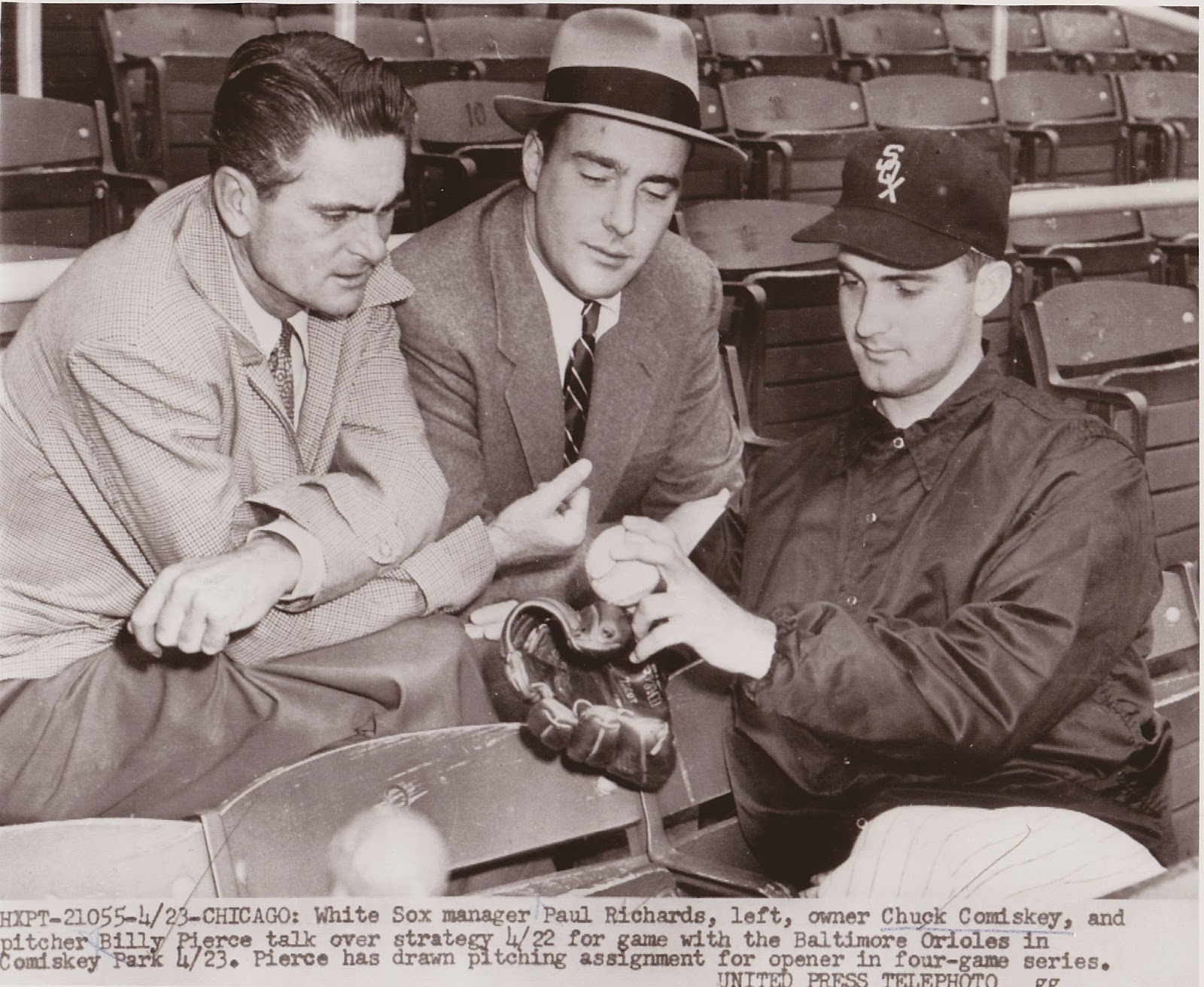
All that is a roundabout way of getting to the posted item, a wire service photo from 1954 showing White Sox manager Paul Richards, owner Charles Comiskey and pitcher Billy Pierce. They are supposedly discussing Pierce's upcoming start against the Orioles but in a posed shot like this they were probably just shooting the bull while waiting for the United Press photographer to finish.

I picked this one up off eBay just to add it to my Billy Pierce collection as an oddball item. The game referenced in the caption was played on April 23 of '54 in Chicago and the Orioles beat Pierce 3-1 in 10 innings. Catcher Ray Murray drove in the winning run in the top of the tenth with a double. Pitcher Joe Coleman, who had already gone nine for the Orioles, then came up to hit and drove in an insurance run. Hard to imagine a starter getting a chance to hit in the 10th inning in these days of closers and set-up man. That game by the way, was just the eighth game in the history of the modern Orioles franchise. And it was the last time they were at .500 for the year. They lost the next three in Chicago, 8 of their next 9 overall and finished the '54 season at 54-100 in seventh place 57 1/2 games back of the league champ Indians.

And they lost to Billy Pierce 11-0 on the last day of the season.

Friday, March 7, 2014

Autographed Orioles B&W Postcards


While I was digging around for yesterday's post subject, the Dexter Press postcards, I found these and four more just like them in the same binder. Normally with any type of Orioles memorabilia, particularly something I have several of, I'd remember where I picked them up. Or at the very least I'd remember having them at all.

Not so with this lot. If you had asked me on Monday if i had any signed black and white Orioles postcards I'd have said no... and felt pretty confident in saying it.


The Paul Richards card and the George Kell have standard postcard backs with a divider between the block for the address and the greeting along with the stamp block. These early cards are classified as 'Real Photo" postcards and are said to have glossy fronts although my Kell is much less so than the Richards. The borderless ones resemble Exhibit cards.


These next two, Jim Hardin and Dave Leonhard, are black and white versions of the team issued postcards that I collected with a frenzy years ago.


I have the identical cards in their color versions (although that typeface on the Hardin is unique (much smaller) among my Oriole postcards. I don't know if the team gave these B&W cards to the players to send out with autograph requests. If so, why not use the color variety that are so prevalent? The two guys who have compiled checklists of Orioles team issued postcards don't even list black and white ones. Interesting.

Both of these are blank-backed as were all the color versions from that era. Also blank-backed is the Harvey Haddix card below. It's interesting in that it it appears to follow exactly the format of almost all Orioles team-issued cards from my collection. But Haddix' time with the Orioles ended in 1965. I have no Oriole postcards in that style from earlier than 1970. I know the team issued them since 1954 but I have never seen one from the early/mid-60s in this style. Looks like some detective work is in order for me.


UPDATE: The Whitey Herzog postcard below was on eBay and follows the same style as the Haddix. So it looks like the Orioles used that same typeface and style quite a bit during the era of B&W postcards.


Bonus card... digging further in my binder I came across this Moe Drabowsky signed card stuck in the back with some color cards. It's a JD McCarthy card as evidenced by the name block and the 'JMD' logo that all his stuff has. I touched on the history McCarthy postcards a little bit in a previous post.

Gotta love Moe Drabowsky. Rare is the picture that doesn't show him grinning. He's make for a fun PC. Sounds like a plan.


Sunday, April 21, 2013

1960 Topps Managers, Eddie Sawyer and Paul Richards

A few more from this cool subset of 1960 managers. 


The scholarly Eddie Sawyer held a Masters degree from Cornell, was a college instructor and played minor league ball in the Yankee organization. He served as a player/manager until his friend Herb Pennock brought him into the Phillies chain in 1944 and made him manager of the Phils in 1948.

He managed the team to the NL pennant in 1950 in a hard fought race against the Dodgers. That was easily his most successful year as a manager. He was replaced in 1952 and remained out of baseball until he was hired back in 1958 for a second term as Phils manager. He managed through the 1959 season and then resigned one game into the '60 campaign. 

Would that be an Awesome Night card? We'll have to ask Night Owl


Paul Richards managed the Orioles from 1955 to 1961. Before that he was a catcher with the Dodgers (1932), Giants (1933–35), Philadelphia A's (1935) and Detroit Tigers (1943–46). He managed the White Sox before and after he was at the helm in Baltimore. He also served as the General Manager for the Orioles, the Houston Colt .45s and the Atlanta Braves.

In Baltimore he was credited with developing many of the players that brought the Birds out of obscurity to a second place finish in 1960 including Brooks Robinson and several pitchers including Steve Barber, Milt Pappas and Jack Fisher who made up their young staff.

He also developed the over-sized catchers mitt that Gus Triandos and others used to handle Hoyt Wilhelm's knuckler. Although the Texan never won a pennant he managed 16 players who went on the manage in the big leagues.

His card provides the rare look at Baltimore's Memorial Stadium on a card from this era. My favorite stadium of all.