Showing posts with label Japanese cards. Show all posts

Saturday, April 14, 2018

Japanese Cards Pt 2 The Rectangles

I'm finally finding the time to post the followup to the first half of SumoMenkoMan's generous gift of a padded envelope stuffed with Japanese menko cards. This post shows off the rectangular cards. 

The first four all come from the JCM 2 (Blue Baseball Back) set of 1948.


I first thought the above card was Hall of Famer Tetsuharu Kawakami. A better guess is Takehiko Bessho. The cards come with different backs so identifying them is problematical.

I hope it's Bessho. Read this from Baseball Reference:
A star pitcher in high school, he had one of the most famous performances in the history of the spring Koshien in 1941 when he threw 14 innings despite his left arm being broken and in a sling. He lost the game 2-1 but won widespread recognition for his courage and guts. His catcher had to roll the ball back to him after each pitch and he fielded barehanded. His explanation was "I want to play as much baseball as I can before I die."
The scrambled reverses mean I'd be guessing on some of these. But these are among the most colorful and detailed cards I own. The second card IS Tetsuharu Kawakami.


This one of the pitcher in the striped uni is my favorite. I'm fairly certain that it's Juzo Sanada. I had a copy of this card previously but this one is focused properly.


The next card is likely one of the two generic players depicted in the small set. If not then it's Torao Ooka.

The backs reflect the set's name.

I can't find a match for this card in the guide. The colorized photo image suggests the 1950s but who knows? It's about the size of the Topps mini cards they put out now in Gypsy Queen, etc.


The back is interesting. I figured I'd spot the set with a parachute on the reverse pretty easily but I can't find it.


This die-cut was the example used in the guide making it a snap to ID. The player is Rentaro Imanishi and the card is from the 1949 Hoshi Gangu set JDM 21. After a solid rookie year in 1946 he won 73 games over four seasons. Then he seemed to flame out and never had more than two wins a year after that.


We jump to 1958 for this card from the Doyusha borderless set JCM 30a. The player is Katsuya Nomura who was active in the Japanese pro ranks as a player and manager from 1954 to 2009.


This is the first team card I've ever come across. The back is identical to the cards in the 1976 Viking set but Engel's guide doesn't mention any cards but those of players. And the ink color used on the back of the '76 set was black. Call this one a mystery.


We jump ahead to a more modern set, the JCM 55 1962 Doyusha Menko. This one is in rough shape but it's still pretty sweet. Shinichi Eto was a catcher/1B for the Dragons for 11 seasons and won a couple of batting titles. He played a total of 18 seasons.


This next one is one of two cards issued for Shigeo Nagashima in the 1959 Marusho Two Bat JCM 38b set. He played his entire 17-year career at 3rd base for the Yomiuri (Tokyo) Giants.


And finally, we have a card from an almost modern Japanese set, JCM 15b, the Kankan menko from around 1973. These are very thick, sturdy cards with nice photography. A similar set on thinner cardboard had been issued the previous year. This is Koji Yamamoto of the Hiroshima Carp. He had an 18-year career with them as an outfielder and later served as their manager for 10 seasons.


It's fairly common for the backs to be off-center even for cards which are centered on the front.


That wraps up the great envelope from Ryan. Posting it late doesn't reflect on how much I appreciated it. Thanks again, Ryan.

Friday, April 6, 2018

Japanese Menko Cards Pt 1 The Circles

Hello again. I'm back after taking a mini break from the hobby.

I need to catch up and post about one of the best mailers I've ever received. It came from Ryan aka SumoMenkoMan who authors the very interesting blog of (nearly) the same name. The envelope was totally unexpected and quite welcome. As you'd expect it contained Japanese menko cards, lots of 'em. So many that I thought it best to make two posts about them.

In this post I'll showcase the round ones. Identifying baseball menko sets isn't hard if you have the right tools, Gary Engel's guide for example. Ryan himself has info on his blog mostly geared towards sumo rather than baseball menko. He's written a guide to those btw.

ID-ing players on these cards is more problematical, at least for me. But that hasn't stopped me from enjoying them. I'm posting these from smallest to largest grouped (I think) by set. Scanning limits your ability to show the precise sizes and tends to cut off the edges of these but no matter, I'll plow ahead.

Of course the first one I stick up here I can't identify as to the exact set. That figures. The various elements match several different cataloged sets but none precisely. But it looks to be from the late 40s. I'm sure Ryan or one of the other menko experts that frequent the blogs can set me straight.


Whiffed on this one as well. Can't find a set that has a design quite like that..and no set in the guides shows a card with a number with that many digits. I feel like his face is familiar but I'm drawing a blank. 


Finally, a couple that I can identify. These next two are from the 1949 ten card JRM2 Starburst set. This batter is Hiroshi Oshita. I like this one a lot. Great little details in the catcher and ump. Oshita is a Hall of Famer.


This next guy I also recognize. He is Henry "Bozo" Wakabayashi. He's a Japanese baseball Hall of Famer and has a compelling story.

here is a JRM 14 from 1950ish. I thought I had deciphered the Kanji as Matsumoto but that doesn't appear to be the case.

The next five as bigger (obviously) and are from sets in the circa 1948 JRM 1 family. There are differences in sizes and small details but they all have the same basic design. In some the team name is in parenthesis.


The next three are JRM 26 Pinwheel menko. First up, Masayasu Kaneda.


Michio Nishizawa turned pro at 15 and excelled as both a pitcher and as a first baseman/outfielder.


Finally here is Hideo Fujimoto. This is one of two cards I had in my collection albeit in slightly different sizes.

I had a version of this next card as well. This is a JRM 20 of Bozo Wakabayashi seen above in another card. He was a two time Japanese League MVP.


This final card in today's post was easy to identify as it is the same card Engel uses in his set description. It's a large size JRM 37 from 1958. The player on top is Michio Nishizawa but the others are listed as 'unknown' Chunichi Dragons.


That wraps up the circular versions of the menkos I received from Ryan. Wonderful, colorful cards aren't they? I love 'em.

Next time (when I return from a short trip to San Antonio, I'll post the rectangular ones. Those may be even sweeter.

どうもありがとうございます Ryan.

Wednesday, April 19, 2017

#30DBCC Days 11-20 Recap


The 30 Day blog and /or Twitter Challenge has been both fun and thought provoking for me. I've gone through binders I hadn't looked at in a long time. At least twice I posted a card for a daily challenge and then later thought "that card would have work better for THIS one."

Anyway, here is the next installment, Days 11 through 20.

Day 11...a favorite card from the 70s. I went with the Jim Palmer Kellogg's card for a couple of reasons. I have plenty of them for one thing. And they are just plain neat cards. The 3D aspect was unique then and nobody has done it as well since. 

I could have put the '78 Murray rookie here but that one would have fit in several other places. I already used it a a favorite rookie card.


Day 12. A favorite from the 80s. Rochester Cal Ripken. The only card I own that I ever considered paying to have graded. I have two of these, the other is on display on my shelves. That one isn't off-center.


Day 13. A favorite from the 90s. I was a David Clyde fan since I watched him as a high school phenom. He was a man playing against boys.


Day 14. A favorite from the 2000s. 2008 Topps Barack Obama. No comment other than I remember buying one pack of 2008 Topps cards at a Wal Mart and opening them in the parking lot. I remember being disappointed in the design. 


Day 15. A favorite from the 2010s. I could have chosen any of about a hundred great Stadium Club cards from the last three years. This one is about as good as a card gets.


Day 16. A card of a guy I didn't like but admired. .My only decision was which Reggie to post. I chose a great one I picked up from the late Bob Lemke. RIP Bob


Day 17. A card from the first set I put together by hand. .I decided to use a card from my first major set blogging project, '59 Topps. I'm sure i put together several sets as a kid but I couldn't swear which the were. Probably '62 or '63. Those were school yard sets projects. Picking the '59 gave me the chance to post this great Frank Robinson card.


Day 18. A card of a player who went on to manage your fave team. Could have used a Frank Robinson card here as well. I scanned his rookie card but then decided to use a Bauer for variety. This one had just arrived as an upgrade for the '58 binder.


Day 19. A favorite from outside the USA. This one was right in my wheelhouse. I flipped thru my Japanese card collection and chose three different Sadaharu Oh menkos. 

I'm in doubt about the legitimacy of this one:


I like this one .....


....but I like this one the most!!


And finally we get to Day 20: A parallel you like not for the player but the design.  I pay next to no attention to parallels so I was at a disadvantage on this one. First one I found was this framed Brooks from an Upper Deck set. Winner by acclamation I guess. 


I'm in the midst of pulling and scanning for the final leg of the challenge. They may be the most fun of them all. I hate to see the end of the 30 days coming at me.

I'll post those once the challenge is done.

Saturday, February 25, 2017

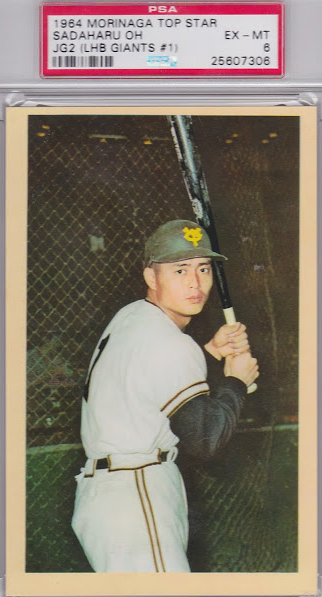
1964 Sadaharu Oh Morinaga Top Star


A couple of years back I was able to knock off a 'white whale' of sorts when I picked up a Sadaharu Oh Menko card. Once I'd done that the Japanese homer champ sort of fell off my radar, but not my eBay 'Followed Searches' list. I'd check from time to time but nothing came up that was both interesting and affordable. Then I saw this.

A few weeks back the colorful and fascinating Japanese Sumo Wrestling Cards and Menko blog a Sumo card from the 1964 Morinaga Top Star series was featured. Sumomenkoman (I have no idea what his actual name is) mentioned the fact that Oh has a card in one of the two different varieties of the baseball version of the set. The Top Star cards are either die-cut (JG 1) or not (JG 2). This Oh card is part of the latter category. I went to eBay and found one with a decent opening bid and I placed one myself figuring I'd lose out.

But I won and this showed up yesterday. It's an oversize card issued by the still prosperous Morinaga & Company confectionery company of Tokyo. They've been in business since 1899. There isn't a whole lot of info on these on the web but they seem to be popular items on auction sites. Here is a bit of background from one of them:

From Heritage Auction:
1964 MORINAGA "TOP STARS". In 1964, there were actually two distinct baseball card issues created by Morinaga. Substantially more common (though quite scarce in its own right) was the production known [...] as "JG 1."  It was a die-cut affair, providing admirers the ability to fashion stand-up figures.  However, Morinaga also made a non die-cut variety (JG 2).  Currently, there are eleven different confirmed [that # is debatable, see below]...... They measure 3 1/2" x 5 1/2" and include vital information on the reverse. 
A look at the back shows minimal type that includes the player's vitals. The die-cut version have instructions for making the card a 'stand-up'.


Gary Engel's Japanese Baseball Card checklist/price guide lists the set as JF 2 rather than JG 2 and I'd tend to go along with his designations. He's an expert on cards such as these. I scanned his checklist out of my copy of the book. 12 baseball players are included here as opposed to the auction site's statement that there are 11. .


For perspective I scanned the Oh with a random modern Topps card.


I rarely go after graded cards and when I do there is always a debate going on in my head as to whether or not I should break them 'free' of their plastic prison. I think in this case (no pun intended...or was there?) I'm going to leave Mr. Oh alone. At least for now. I'd rather not risk damaging the card. I've had a few close calls. But either way this is a most welcome addition.